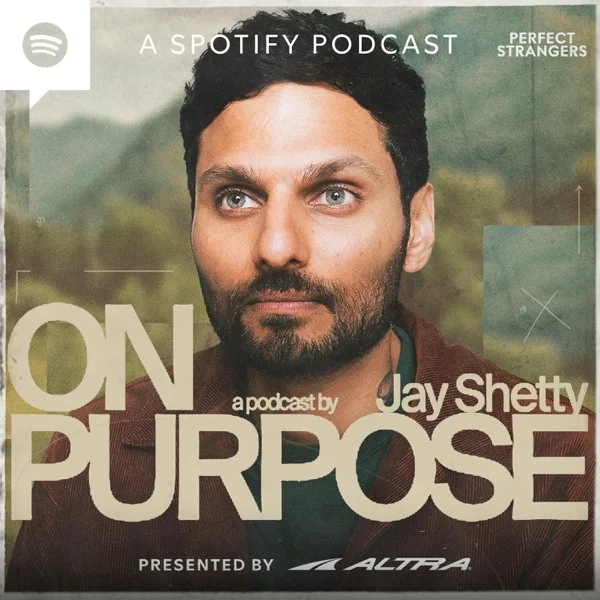
The 12 Best On Purpose Episodes, Summarized
The best Jay Shetty podcast episodes from the past year of On Purpose, ranked and summarized: key takeaways, tools, and quotes from Matthew McConaughey, Chris Hemsworth, James Cameron, Michael Pollan, and more. Free to read in full.
1% BetterOn Purpose with Jay Shetty is one of the most listened-to wellness podcasts in the world, which makes 'where should I start' a fair question. This guide answers it for the show's recent run: we summarized every On Purpose episode in our library from roughly the past year, covering each full conversation, then ranked the twelve that deliver the most usable ideas per minute.
Each entry tells you why the episode earns its spot, the specific takeaways worth acting on, and a quote that captures the conversation. Every summary links to our full episode breakdown, completely free. If you only have one commute, start with number 1.
A note on scope: these are the strongest episodes from our summary library, mostly from the past year, so treat this as a snapshot of recent On Purpose and a great on-ramp to the show. Three threads run through the list: reinterpreting fear and anxiety as fuel, taking authorship of your life one step at a time, and reclaiming your attention in a distracted world. We unpack those threads after the list.
1. Matthew McConaughey: The Biggest Mistake You Are Making in Life
On Purpose · Jay Shetty · Matthew McConaughey
The richest mindset episode of the recent run. McConaughey turns midlife reflection into a practical toolkit: redefine humility as admitting you have more to learn, give amnesty to the version of you that got you here, and when life overwhelms you, find the single next solid step and take only that. His Bhagavad Gita framing, hold the big picture in mind while you fight for the next move, is the throughline that ties his whole philosophy together.
Key takeaways
- Redefine humility as admitting you have more to learn. That reframe lets you stand tall and keep growing at the same time.
- Give credit to what got you here. The mindset that feels outdated now was exactly right for its moment, so look back with humor and amnesty.
- When you feel overwhelmed, find one solid step and take only that. Momentum builds from 'one in a row,' repeated until you look up and see progress.
- Balance faith and action: hold the bigger picture in mind while you take decisive, present-tense steps.
Humility is admitting you have more to learn. — Matthew McConaughey
2. James Cameron: Why Titanic Was a Huge Risk
On Purpose · Jay Shetty · James Cameron
A creativity masterclass from one of cinema's great risk-takers. Cameron defines an artist as someone who has to force themselves to stop creating, reframes memory as the story we tell ourselves, and delivers the single most quotable career line here: when a door opens, understand it is the opportunity, and walk through it. Seeing Star Wars top the box office is what convinced him there was a market for his imagination, and he quit his job to chase it.
Key takeaways
- You are an artist when the ideas flow on their own and the effort goes into pausing them. That compulsion is the signal to build a creative life.
- Memory works like storytelling: we keep the story we tell ourselves about an event, which is worth remembering when you shape your past into creative work.
- Fortune favors the prepared mind. Read, learn, and build skills now so you recognize the opportunity the moment its door opens.
- Great work comes from a grand provocation: set an inspiring challenge, then let curious, talented people investigate it.
Opportunities come along and they're fleeting and that door will open for a moment and then it'll slide closed. Fortune favors the prepared mind. — James Cameron
3. Chris Hemsworth: Anxiety, Imposter Syndrome, and His Dad's Alzheimer's
On Purpose · Jay Shetty · Chris Hemsworth
Hemsworth opens up for the first time about anxiety and imposter syndrome, and the science he lands on is immediately usable: the physical signature of fear and excitement is identical, so the label you choose changes the experience. He pairs that with a performer's paradox, care deeply about the work while fully letting go in the moment, and a childhood in remote Australia that gave him a lifelong appetite for adventure.
Key takeaways
- Anxiety and excitement share the same body signals. Narrate the racing heart as 'my body preparing me to perform' and the sensation starts working for you.
- Treat nerves as a gift, your instincts coming alive, and befriend the feeling before a high-stakes moment.
- Excellence needs controlled obsession: prepare intensely, then release the outcome and stay present in the performance itself.
- Acting builds empathy because every character, even a villain, sees themselves as the hero. Practicing that perspective widens your own.
You got to make friends with it. You got to look at it. It's very hard to recognize now, but it is a gift in that sense. It is your spidey senses coming alive. — Chris Hemsworth
4. Michael Pollan: Life Is Short (How to Spend It Wisely)
On Purpose · Jay Shetty · Michael Pollan
The most intellectually expansive episode on the list. Pollan investigates consciousness and turns it into a call to reclaim your attention: technology now hacks the deeper layers of emotional attachment, and the boredom we once filled with daydreaming has been handed to algorithms. His practical fix is small and daily, put the phone away in moments of waiting, and his account of how a lighter grip on the ego expands awareness gives the whole thing depth.
Key takeaways
- Technology is engineered to occupy your consciousness, moving from capturing attention to hacking emotional attachment. Guarding your attention is now a daily practice.
- The ego is useful and also a wall. Experiences that soften it, meditation, awe, deep focus, paradoxically expand your awareness and connection.
- Boredom is where creativity lives. Leave a few gaps in the day unscrolled and let your mind wander, plan, and observe.
- Meditation and psychedelics share a path: both quiet external distraction to reveal what is happening inside.
The self or the ego builds walls. It's a defensive structure finally. It's very useful without question. But it disconnects us. It makes us selfish. — Michael Pollan
5. Mark Rober: If You're Creative but Lazy, Watch This
On Purpose · Jay Shetty · Mark Rober
The former NASA engineer behind some of YouTube's biggest science videos hands you an operating system for ambition. His core move is naive optimism, believing you can do the thing before you know how hard it is, paired with an engineer's relationship to failure: a dead end is a data point, the way a gamer treats dying as 'try again.' Add 'moonlight your passion' and 'hide the vegetables,' and you get a blueprint for building something that lasts.
Key takeaways
- Think like an engineer: failure is part of testing the limits, so frame a setback as 'what did I just learn' the way a gamer restarts a level.
- Naive optimism is a superpower. Believing you can do it before you grasp the full workload keeps you moving toward the goal.
- Moonlight your passion. Build it on nights and weekends while a steady income gives you runway to prove you love it.
- Hide the vegetables: the best teaching leads with wonder and spectacle, then embeds the lesson inside the fun.
No one picks up a controller to play a video game and falls in a pit and thinks I'm a failure. You're immediately like oh what did I just learn from that? — Mark Rober
6. Alex Honnold: The Mindset Behind Free-Soloing the Tallest Building in Taiwan
On Purpose · Jay Shetty · Alex Honnold
The world's most famous free soloist gives the clearest field guide to fear you will hear. His central reframe is that fear is a sensation like hunger, a signal to evaluate calmly once you have felt it thousands of times, and thirty years of climbing five days a week is what rewired his response. He separates roped climbing, where you push past your limits to grow, from free soloing, where you stay well within them, a distinction that maps neatly onto everyday risk.
Key takeaways
- Fear becomes manageable through repeated exposure. Treat it like hunger: a signal to acknowledge and act on calmly, built through practice.
- Climb with your legs, using your hands for balance like a handrail. Efficiency comes from the biggest muscles doing the work.
- For irreversible stakes, stay well within your limits. Save the limit-pushing for situations where a fall is recoverable.
- Fear and excitement feel the same in the body. Ask which one you are feeling and reframe the sensation toward excitement.
Fear is a sensation in your body. Same as lots of other things. It's like hunger, you know? — Alex Honnold
7. Money Experts: If I Had to Start at $0 Today, Here's How I'd Build Wealth
On Purpose · Jay Shetty · Scott Galloway & Jaspreet Singh
Scott Galloway and Jaspreet Singh compress a finance education into one sitting, and the advice is refreshingly mechanical. Automate savings so the money moves before you can spend it, reclaim eight to ten hours a week from your phone and point it at income, and understand that wealthy people work to own the ladder through investments and assets. It is the most actionable money episode here, built for anyone in their twenties who wants a real head start.
Key takeaways
- Forced savings beat willpower. Only 17% of Americans automate deposits, yet automation is the most reliable path to wealth because the money moves out of reach on its own.
- Time is your biggest asset when young. Reclaim eight to ten hours a week from phone distractions and point it at earning.
- Saving alone loses to inflation. Money is both currency for spending and a store of value, so move savings into assets that hold and grow.
- Own the system as well as climb it. Wealth comes from ownership through investing, real estate, and income-producing assets.
Saving isn't about willpower. It starts with having something to save. Reclaiming just 8 to 10 hours a week from distractions like Tik Tok or gaming could shift your financial future. — Scott Galloway
8. Luke Combs: Living with OCD, Guilt, and the Ability to Suffer
On Purpose · Jay Shetty · Luke Combs
Country's biggest star reframes his defining trait as an ability to suffer, and years of managing undiagnosed OCD gave him a mental-health toolkit that now steadies his music and his parenting. His method is precise: recognize the thought pattern early, refuse to feed intrusive thoughts with attention or reassurance, and sit with anxiety like a rip current until it loosens. His take on presence, fully home when he is home, lands for any busy parent.
Key takeaways
- Success magnifies your existing character. Grounded traits expand with fame, and so do the rough ones, so build the good ones early.
- Study your own patterns. Understanding your triggers turns you into the expert on managing your mind and catching episodes early.
- Starve intrusive thoughts of attention. Like a rip current, the calm move is to stop struggling and let the thought pass.
- Quality time means full presence. When Combs is home he cooks, changes diapers, and gives baths at full attention.
I think I have a tremendous ability to suffer. — Luke Combs
9. Nick Jonas: The Traumatic Birth of His Daughter and Rebuilding Identity
On Purpose · Jay Shetty · Nick Jonas
Jonas gets unusually honest about the layered ways we criticize ourselves and the identity trap of building your whole self on one skill. The most useful thread is how creation became his family's lifeline: during the season they lost their home and record deal, and Nick was diagnosed with Type 1 diabetes, they wrote music in the basement every day and broke through. His line about being nicer to the person in the mirror will stay with you.
Key takeaways
- When life hits hardest, make something. The Jonas family wrote daily through their darkest season and the momentum carried them out.
- Early labels become invisible cages. 'The shy one' can follow you for years through self-talk until you consciously shed it.
- The inner critic compounds: you judge the mistake, then judge yourself for judging. Naming the loop lets you choose self-compassion.
- Build an identity larger than your craft. Resilience comes from knowing who you are when the one thing you do is taken away.
Hit me like a gut punch. I hurt my own feelings. How did I get so good at being mean to myself? What would it be like if I just tried to be nice to the person that I'm seeing in the mirror? — Nick Jonas
10. Alex Warren: The Untold Story of Losing His Parents, Addiction, and Survival
On Purpose · Jay Shetty · Alex Warren
One of 2024's breakout musicians tells a hard story with real grace: father gone at nine, an alcoholic mother, homelessness as a teenager, and a climb to success powered by daily action toward a dream few people supported. The standout idea is grace through context, the compassion he found for his mother by picturing what she carried, and his honest reflection that achievement feels hollow without the people you wanted to share it with.
Key takeaways
- Turn pain into purpose with daily action. Warren posted videos and practiced every day through homelessness because belief outweighed his circumstances.
- Grace grows from context. Picturing what someone carried, a widow raising four kids alone, makes compassion possible for them and for yourself.
- Achievement feels fuller with people to share it. Meaningful relationships, more than milestones, define what an accomplishment means.
- Approached well, conflict deepens a relationship. Warren treats arguments as learning what you can each live with.
How am I supposed to judge someone who watched her husband die and then had to raise four kids by herself? — Alex Warren
11. If You Are Experiencing Grief Today, This Episode Is for You
On Purpose · Jay Shetty · ft. Kate Cassidy, Nicole Avant, Karan Johar
Jay Shetty weaves three conversations about loss into the most comforting episode on the list. The reframe that anchors it is a shift from 'but' to 'and,' holding the trauma and the celebration of a life at once, so bitterness has less room to grow. Kate Cassidy on daily rituals and signs, Nicole Avant on forgiveness as releasing a burden, and Karan Johar on speaking everything while you still can make it practical as well as moving.
Key takeaways
- Grief moves in unpredictable waves. Trust your instincts and let each feeling arrive without judgment.
- Small rituals anchor you. One daily practice, a walk, a shared song, a bake, preserves your footing through intense loss.
- Shift from 'but' to 'and.' You can hold the trauma and celebrate the life at the same time, which keeps bitterness from taking root.
- Communicate today. Open conversations about regrets and love while you can create the closure that lasts.
- Grief is the receipt of deep love. Its intensity measures the connection, and healing means carrying that love forward.
Grief is the receipt from the universe showing that you loved someone or something and loved them very deeply. — Penny (via Nicole Avant)
12. Confidence Expert: A 4-Step Blueprint to End Self-Doubt
On Purpose · Jay Shetty · Dr. Shadé Zahrai
A research-backed breakdown of self-doubt that gives you a target to aim at. Self-doubt splits into four measurable drivers, and identifying your primary one focuses the fix. The most powerful move here is a simple shift of attention from 'how do they see me' to 'how can I serve them,' which quiets the ego and builds real confidence. The invisible-scar study she cites shows just how much your self-image shapes the reality you live in.
Key takeaways
- Self-doubt has four measurable drivers. Identify your primary one and you can target the solution with precision.
- Shift from self-focus to service. Trading 'how do they see me' for 'how can I help them' quiets the ego and steadies confidence.
- Turn comparison into emulation. Study successful people for their strategies, converting 'I'm behind' into 'if they can, I can.'
- Creative hobbies build self-acceptance. Nobel winners were far likelier to have artistic pursuits that anchor identity beyond work.
You are not your thoughts and you are not your beliefs. Beliefs are simply just a repeated pattern of thought that has happened so many times in our brain that it becomes a default. — Dr. Shadé Zahrai
What these episodes have in common
Theme 1: Fear and anxiety are signals you can reinterpret
Three of the strongest episodes arrive at the same neuroscience from different worlds. Chris Hemsworth, on a film set, and Alex Honnold, on a rope-free wall, both land on the identical point: the body produces the same signature for fear and for excitement, so the label you attach decides the experience. Luke Combs adds the harder version, learned from years with OCD: when anxiety surges like a rip current, the calm move is to stop struggling and let it pass. Put together, they describe a single skill. Feel the sensation, name it accurately, and let it inform your next move.
The through-line is exposure. Honnold's thirty years of daily climbing rewired his fear response the way repetition rewires any skill, and Hemsworth befriends his nerves before every performance. Confidence here is a practice you build, one uncomfortable rep at a time.
Theme 2: Authorship, one step at a time
Matthew McConaughey, Alex Warren, Nick Jonas, and Mark Rober are telling one story in four keys. McConaughey reduces an overwhelming life to the single next solid step and repeats it until progress appears. Warren posted a video and practiced every day through homelessness. The Jonas family wrote a song a day through the season they lost everything. Rober frames each failure as a gamer's restart, powered by naive optimism. The shared belief is that momentum comes from small, owned actions taken daily, and that circumstances matter less than the decision to keep moving.
Theme 3: Reclaim your attention and your authentic self
Michael Pollan, Dr. Shadé Zahrai, and James Cameron converge on a quieter theme: the self you protect and the attention you spend. Pollan shows how technology colonizes the consciousness we once left open for daydreaming, and prescribes small daily boundaries around your phone. Zahrai locates confidence in a shift of attention from how others see you toward how you can serve them. Cameron, meanwhile, chases forms with fewer filters between his real self and his audience, asking what his 'documentary' would show. The common instruction: guard your attention, soften the ego's grip, and let something more authentic come through.
Every episode referenced
- Matthew McConaughey: The Biggest Mistake You Are Making in Life
- James Cameron: Why Titanic Was a Huge Risk
- Chris Hemsworth: Anxiety, Imposter Syndrome, and His Dad's Alzheimer's
- Michael Pollan: Life Is Short (How to Spend It Wisely)
- Mark Rober: If You're Creative but Lazy, Watch This
- Alex Honnold: The Mindset Behind Free-Soloing the Tallest Building in Taiwan
- Money Experts: If I Had to Start at $0 Today, Here's How I'd Build Wealth
- Luke Combs: Living with OCD, Guilt, and the Ability to Suffer
- Nick Jonas: The Traumatic Birth of His Daughter and Rebuilding Identity
- Alex Warren: The Untold Story of Losing His Parents, Addiction, and Survival
- If You Are Experiencing Grief Today, This Episode Is for You
- Confidence Expert: A 4-Step Blueprint to End Self-Doubt
Frequently Asked Questions
What is the best Jay Shetty podcast episode?
From On Purpose's recent run, the strongest all-around episode is Matthew McConaughey: The Biggest Mistake You Are Making in Life. It pairs a reframe of humility as 'admitting you have more to learn' with a practical method for overwhelm: find the one next solid step and take only that. For fear and performance, Chris Hemsworth is the standout; for building wealth young, the Money Experts episode with Scott Galloway and Jaspreet Singh.
Which On Purpose episodes should I start with?
Start with what you need. For mindset and midlife clarity, Matthew McConaughey; for managing fear and anxiety, Chris Hemsworth and Alex Honnold; for money and getting ahead in your twenties, the Money Experts episode; for grief and loss, Jay Shetty's grief episode with Kate Cassidy and Nicole Avant; for creativity, James Cameron and Mark Rober. Each of the twelve episodes here has a full summary, so you can preview the ideas in a few minutes.
What is the On Purpose podcast about?
On Purpose with Jay Shetty is one of the world's most popular wellness and self-improvement podcasts, where former monk Jay Shetty interviews celebrities, athletes, scientists, and authors about mental health, relationships, purpose, and personal growth. Episodes mix vulnerable long-form interviews, like Chris Hemsworth and Nick Jonas opening up, with solo deep dives and expert conversations on confidence, money, and grief.
Who are the best guests on Jay Shetty's podcast?
Recent On Purpose standouts include Matthew McConaughey on humility and taking life one step at a time, James Cameron on creativity and preparing for opportunity, Michael Pollan on reclaiming your attention, Alex Honnold on fear, Chris Hemsworth on anxiety, and Scott Galloway with Jaspreet Singh on building wealth. Musicians Luke Combs, Nick Jonas, and Alex Warren also deliver especially raw, personal conversations.
Where can I read Jay Shetty podcast summaries for free?
1% Better publishes free summaries of On Purpose episodes, each with the key takeaway, four to five detailed insights, and notable quotes. Every episode in this guide links to its full breakdown, and our library also covers shows like The Tim Ferriss Show, Huberman Lab, and The Diary of a CEO, so you can preview any conversation in a few minutes before committing to the full listen.