Microsoft unveiled Maia 300 and said its custom chip family will become the primary inference system for company products and services in 2027.
The big picture: Microsoft is moving a larger share of its AI workload onto hardware it designs itself. The company says Maia will scale to multi-gigawatt deployments in 2027, creating an internal alternative to the GPU systems that dominate AI computing.
- Maia 200 already runs production work for Microsoft Copilot and the company's model team. GitHub Copilot and Microsoft Foundry are scheduled to follow by the end of this year.
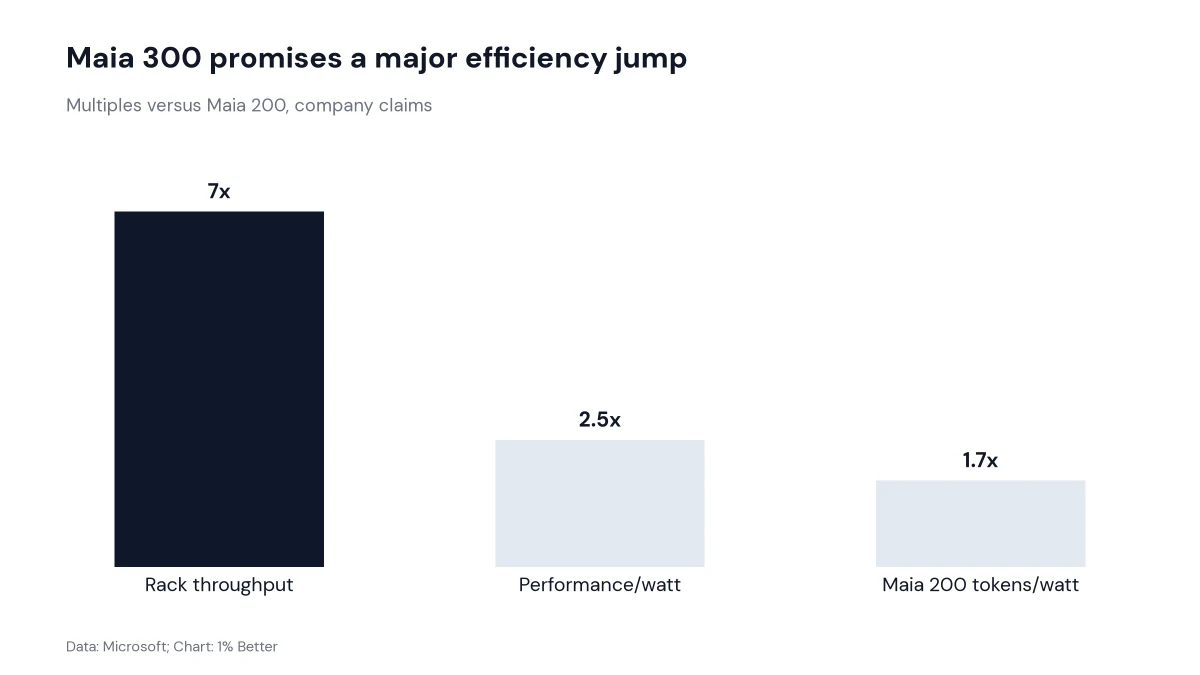
By the numbers: A full Maia 300 rack holds 96 accelerators inside a 167-kilowatt power envelope. Microsoft claims up to seven times Maia 200's rack-scale token throughput and more than 2.5 times its performance per watt.
- Each accelerator carries eight HBM4 stacks with 288 gigabytes of capacity and 18 terabytes per second of bandwidth. The rack combines 27.6 terabytes of HBM capacity and 1.7 petabytes per second of aggregate bandwidth.
Between the lines: The architecture targets inference, the process of serving finished models, rather than model training. Long context, conversational latency and multi-step agents put heavy pressure on memory movement, which Microsoft designed Maia 300 to reduce.
- Compute chiplets use TSMC's N2P process, while memory and input-output functions sit on separate dies. A superpod can connect as many as 12,288 accelerators.
What's next: Production deployments begin in 2027, and Microsoft plans to share more at Ignite next month. The central test is whether its efficiency claims persist under the mixed workloads of Copilot, Azure and enterprise agents.
Why it matters: Custom chips give cloud companies leverage over cost, power use and outside suppliers. Maia 300 also shows how the AI contest is becoming a systems race spanning silicon, networking, cooling, software and the models customers actually use.