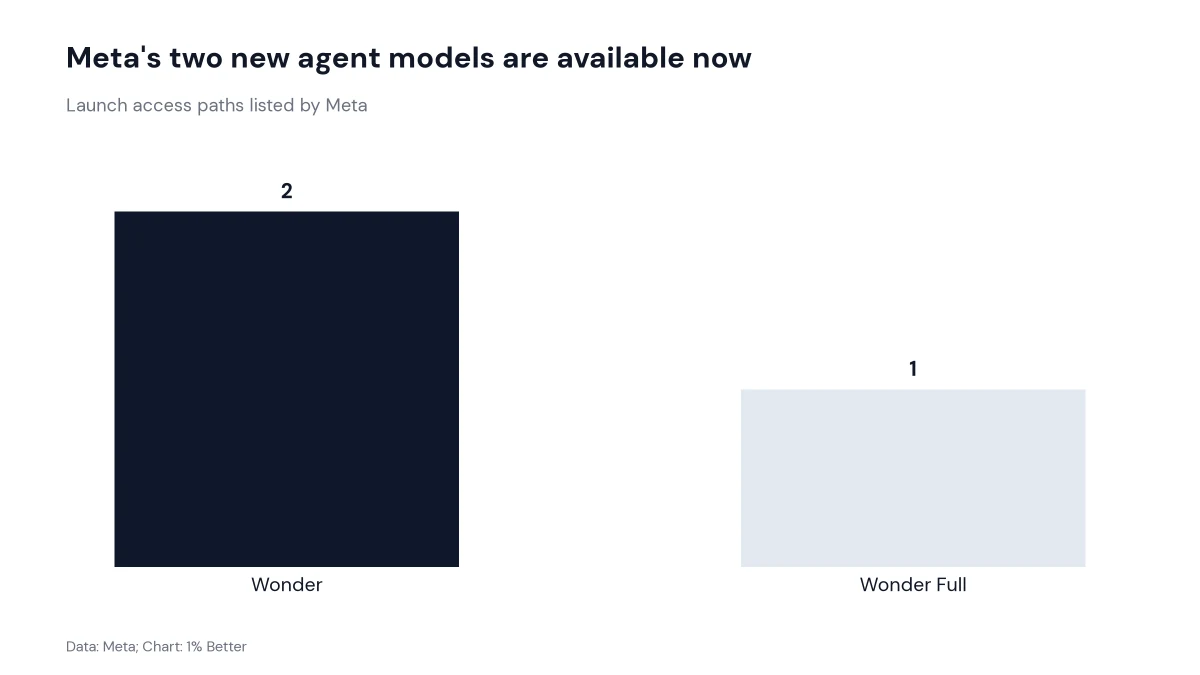
Meta released Muse Wonder and Muse Wonder Full Monday, its newest frontier models for personal and professional AI agents.
The big picture: Meta is shifting its AI pitch from answering prompts to completing work over time. Muse Wonder and Muse Wonder Full are designed for agent tasks that touch law, finance, health and coding, from understanding a lease to building an app.
- Muse Wonder is available through the Meta Model API and Muse Code. Muse Wonder Full is available to Muse Code subscribers, and Meta says Wonder will later power experiences in its Muse consumer agent.
Zoom in: Active Memory carries selected context across conversations and retrieves details relevant to a task. Active Focus lets the model try alternate approaches, recover from errors and ask for clarification before consequential actions.
- Meta says it began overhauling its AI effort 14 months ago and built the Wonder series on Muse Spark. The company calls the new pair its most capable models to date.
Yes, but: The performance claims come from Meta, and its launch post supplies no independent comparison. A fuller safety report is also still ahead, so developers have access before the company publishes all promised evaluations.
- Meta says the models were trained to protect private information, reject harmful requests and still support defensive cybersecurity work. The company points to its Superintelligence Scaling Framework as the release standard.
What's next: Developers can test Wonder now through the API and Muse Code, while consumers wait for the Muse rollout. Real tasks involving messages, calendars and documents will test whether the memory features are useful without exposing sensitive context.
Why it matters: Meta owns apps used by billions of people, giving it a distribution path few AI labs can match. If these models handle long-running work reliably, the AI race moves further from chatbots toward agents with durable memory and access to everyday tools.