Scientists report finding heme, the iron-bearing molecule at the centre of hemoglobin, inside cell-like structures in the bones of a 115-million-year-old dinosaur.
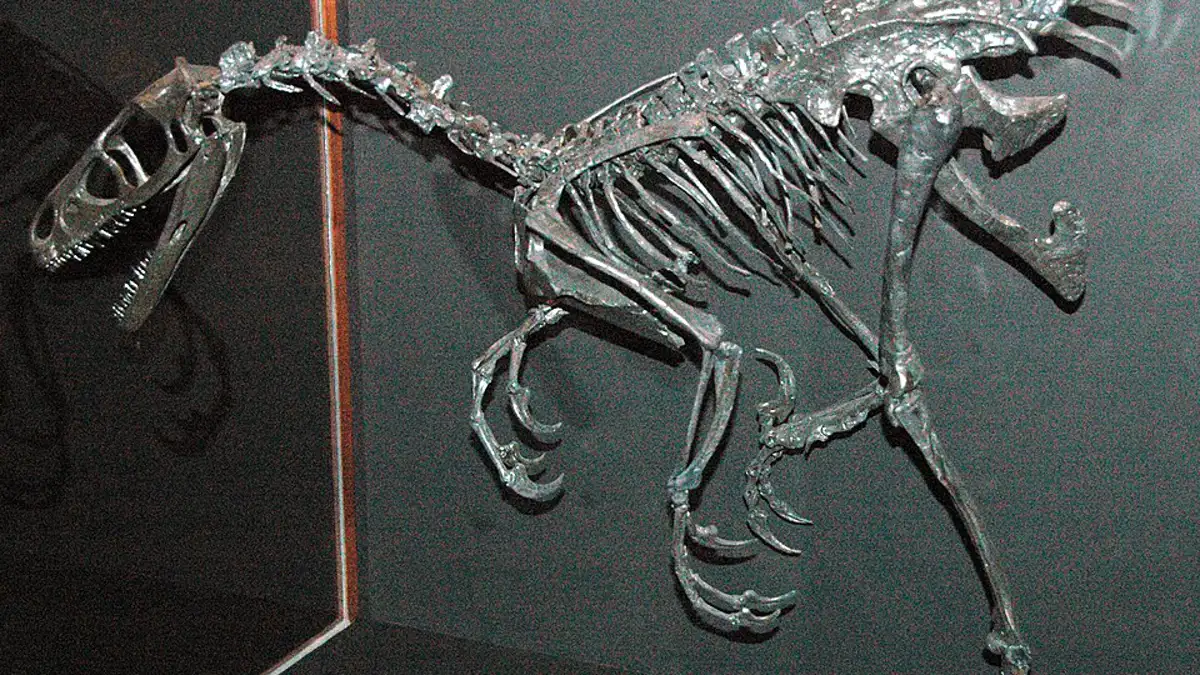
Zoom in: The team analysed hind limb bones of Aratasaurus museunacionali, a feathered theropod from northeastern Brazil, and identified parent and altered heme B inside ellipsoidal microstructures confined to the bone's vascular canals.
By the numbers: The fossil came out of a mine in Brazil in 2008. The animal was about four years old, 34 kilograms and 3.1 metres from head to tail. Tests for ancient DNA came back negative.
- "No-one's actually found heme inside a fossil blood cell ever," said Curtin University professor Kliti Grice, who led the study published Monday in the Proceedings of the National Academy of Sciences.
The big picture: Chromatography and mass spectrometry separated the bone's heme signature from the chlorophyll and bacteriochlorophyll signatures of the surrounding rock, which the authors read as evidence the molecules came from the animal. Raman spectroscopy and electron microscopy then located iron, nitrogen and carbon inside those same structures.
- "What we found is that the bone was almost 80 per cent heme," Grice said, crediting the microbial mat the carcass settled on for the preservation.
The other side: Mary Schweitzer, emeritus professor at North Carolina State University, said the red blood cell data failed to convince her, though she had no problem with heme and collagen in the bone matrix.
- Schweitzer said one image of the cells looked about 15 microns across, smaller than almost all non-mammalian red blood cells, which run larger because they keep a nucleus.
Yes, but: Mauricio Barbi of the University of Regina called the evidence convincing but cautioned that the identification still involves interpretation, and that these are chemical remnants and mineralised structures, not intact blood.
Why it matters: If the reading holds, fossils sitting in museum drawers become chemistry experiments about how extinct animals carried oxygen. Curtin researchers are now testing whether they can mineralise human blood using mats from Shark Bay.