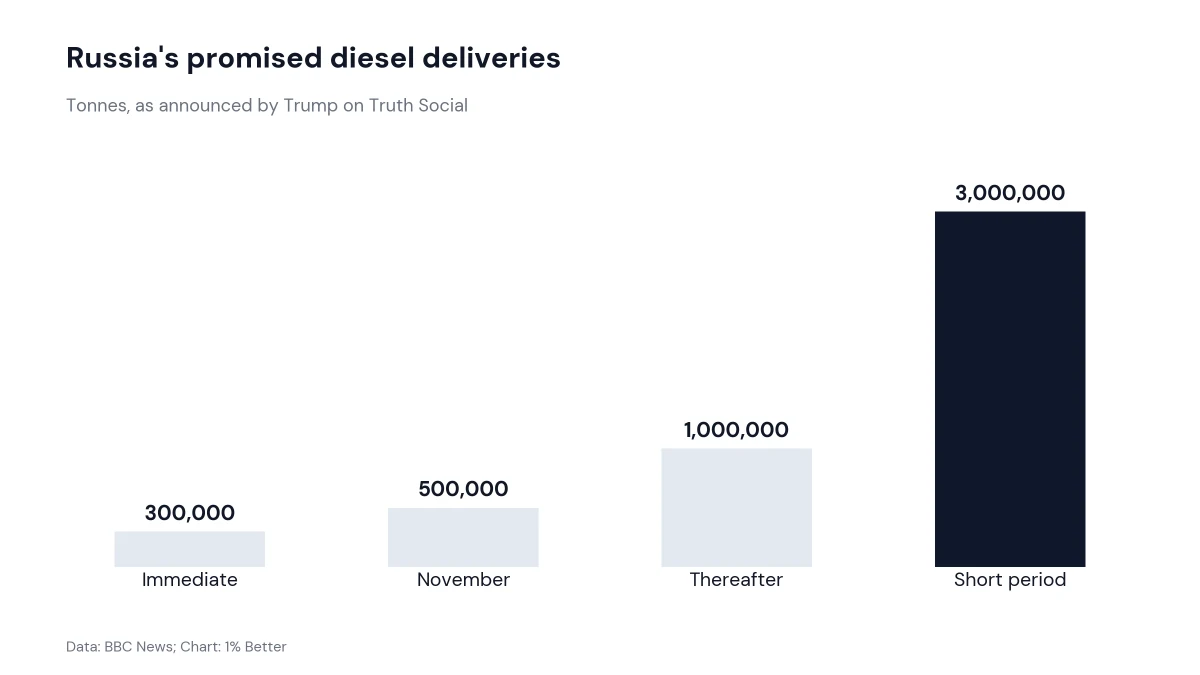
Trump said Putin agreed to release 300,000 tonnes of Russian diesel immediately to the American and global marketplace, followed by 500,000 tonnes in November and a million after that.
The backstory: Diesel prices in the US soared after the Iran war began in February and Tehran closed the strait of Hormuz, which carried 20% of global oil supplies. Brent crude now trades above $103 a barrel, up from about $73 before the war.
- The average US diesel price is $6.28 a gallon, down from a record $6.53 at the end of September, according to AAA.
Zoom in: Trump wrote on Truth Social that a further three million tonnes would follow, depending on the condition of Russian refineries, which Ukraine has been attacking. The US Treasury then issued a temporary licence allowing Russian diesel into the market.
- It plays into Russia’s hands, allowing it to kill more, wage war for longer, have even less respect for America, Zelensky wrote.
The other side: Putin said Russia is willing to supply oil and petroleum products to the US and global markets, without specifying amounts. Congressman Don Bacon, a Nebraska Republican, wrote that propping up Putin’s war economy is morally wrong.
Yes, but: Analysts question the scale. Tim Armitage of Quilter Cheviot said the first tranche equals roughly 2.25 million barrels against daily US consumption of 3.8 million barrels, so it will make little difference to pump prices.
What's next: Trump said this week he was thinking about suspending the federal tax on gasoline, and he has already pressured G7 nations into releasing 100 million barrels of oil and diesel from stockpiles.
Why it matters: Diesel is the main supply chain fuel, so its price feeds into grocery bills, freight costs and farm operating costs, and the midterm elections are weeks away.