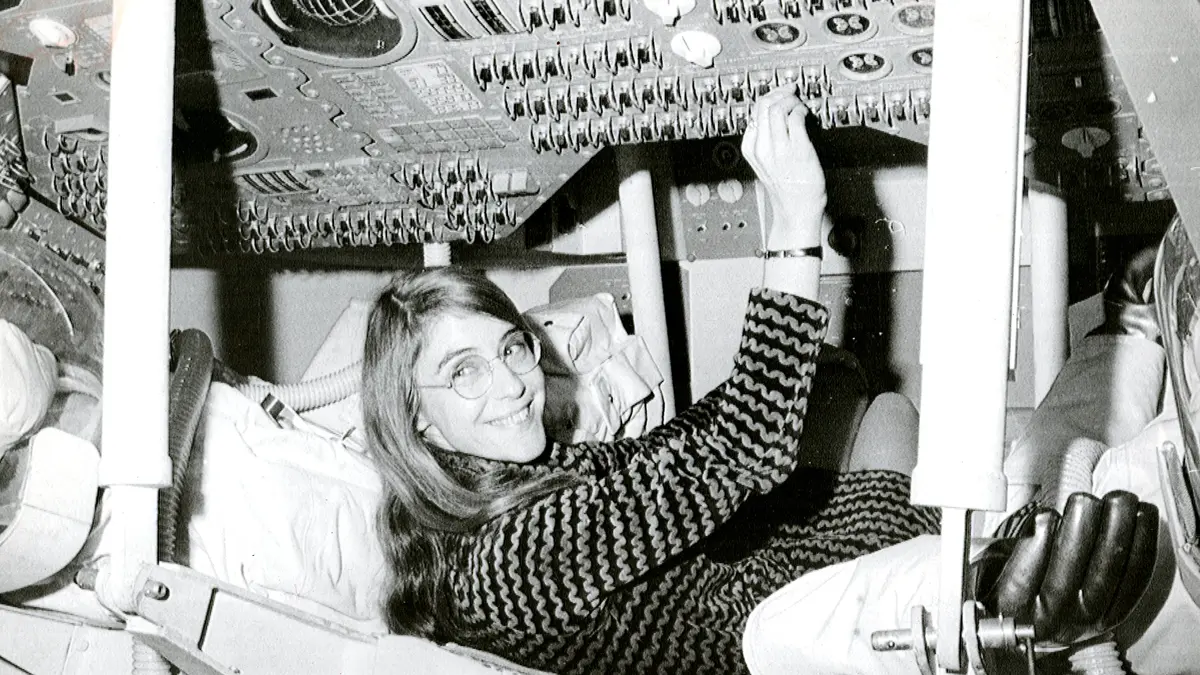
Margaret Hamilton, who led the team that wrote the onboard flight software for NASA's Apollo missions, died on September 30 at 90, MIT announced Wednesday.
The backstory: Hamilton joined MIT's Instrumentation Lab in 1965 after her husband spotted a newspaper ad seeking people to write software to send a man to the moon. She was hired as the first programmer on the Apollo project there, and by 1968 she ran the Command and Service Module team as more than 400 people worked on Apollo software.
Zoom in: Her signature contribution arrived in July 1969. Moments before the Eagle module touched down, the onboard computer flagged a 1202 error: a hardware switch fault had overloaded it during the landing sequence.
- Her team had built priority-driven software that shut down background tasks to protect mission-critical ones. Houston trusted it, the landing continued, and two people walked on the moon.
What they're saying: "She was a software engineer at a time when that field was in its infancy, and she not only developed advanced code herself but also led a team in using that nascent technology to develop one of the most complex systems humanity had ever achieved," said Olivier de Weck, MIT's Apollo Program Professor.
By the numbers: Hamilton authored more than 130 publications, worked at MIT from 1959 into the mid-1970s, and received the Presidential Medal of Freedom from President Barack Obama in 2016.
The big picture: She founded two companies on one idea: Higher Order Software in 1976 and Hamilton Technologies a decade later, both built around error prevention and fault tolerance. The Instrumentation Lab itself spun out of MIT to become Draper Laboratory.
Why it matters: Defensive programming, the practice of writing code that anticipates human error, began as an argument Hamilton lost and then won: she proposed a guard against a crash her four-year-old daughter found in a simulator, was overruled, and watched an Apollo 8 astronaut trigger the same bug in flight.