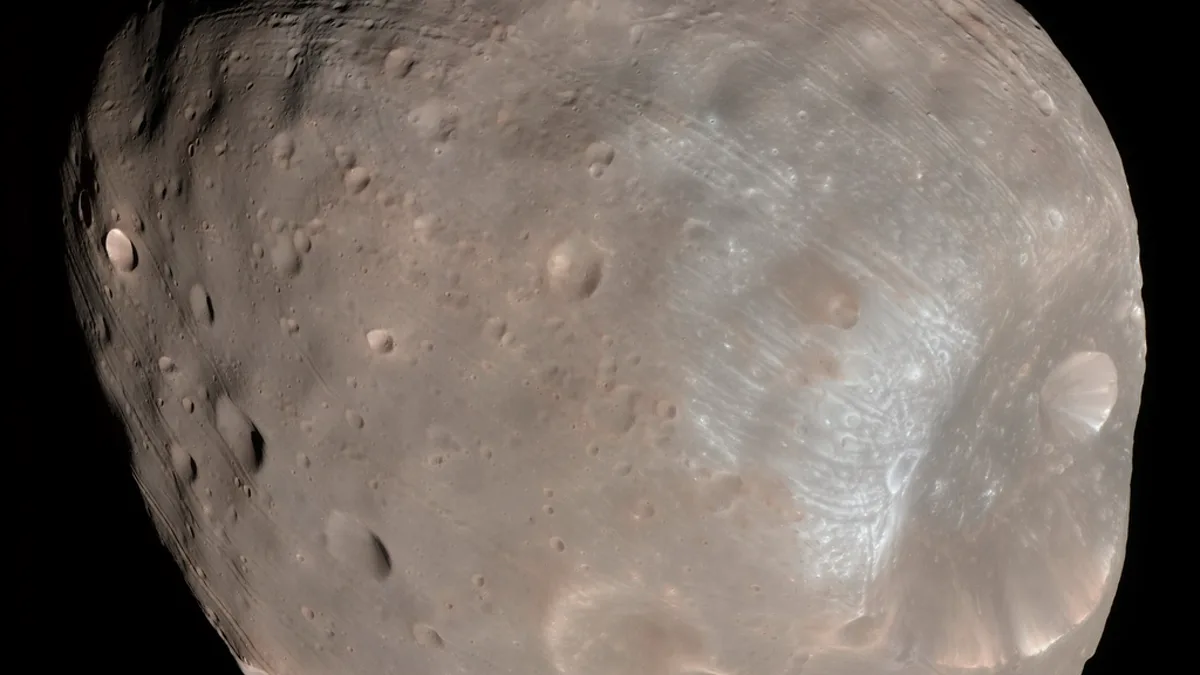
Japan launched MMX toward Phobos, beginning the first mission designed to return physical samples from the Martian system.
The big picture: JAXA's Martian Moons eXploration spacecraft lifted off on an H3 rocket from Tanegashima for a five-year round trip. It is scheduled to reach the Mars system in 2027 and return a capsule to Earth in 2031.
- MMX carries 13 scientific instruments and will observe the topography, internal structure, composition and gravity of Phobos. It will also observe Mars's second moon, Deimos.
- Project manager Yasuhiro Kawakatsu said the samples could show how the Martian moons formed, how the Mars system evolved and where water and organic material on rocky planets originated.
Zoom in: The spacecraft plans two soft landings on Phobos and aims to collect more than 10 grams of rock and sand. An IDEFIX rover will first survey the surface to help the main spacecraft choose a stable landing area.
The backstory: Scientists are testing two leading ideas: Phobos may be a captured asteroid, or it may have formed from debris after a giant impact on Mars. A laboratory sample can reveal minerals and chemistry that remote instruments cannot resolve.
What's next: After roughly a year in transit, MMX will spend about three years operating around the Martian moons. It departs in 2030, and Australia is scheduled to host recovery of the reentry capsule in 2031.
Why it matters: Nothing has ever been returned from the Martian system. If MMX succeeds, scientists will get a controlled sample that can answer how Mars gained and lost water while proving technology needed for future round trips deep into space.