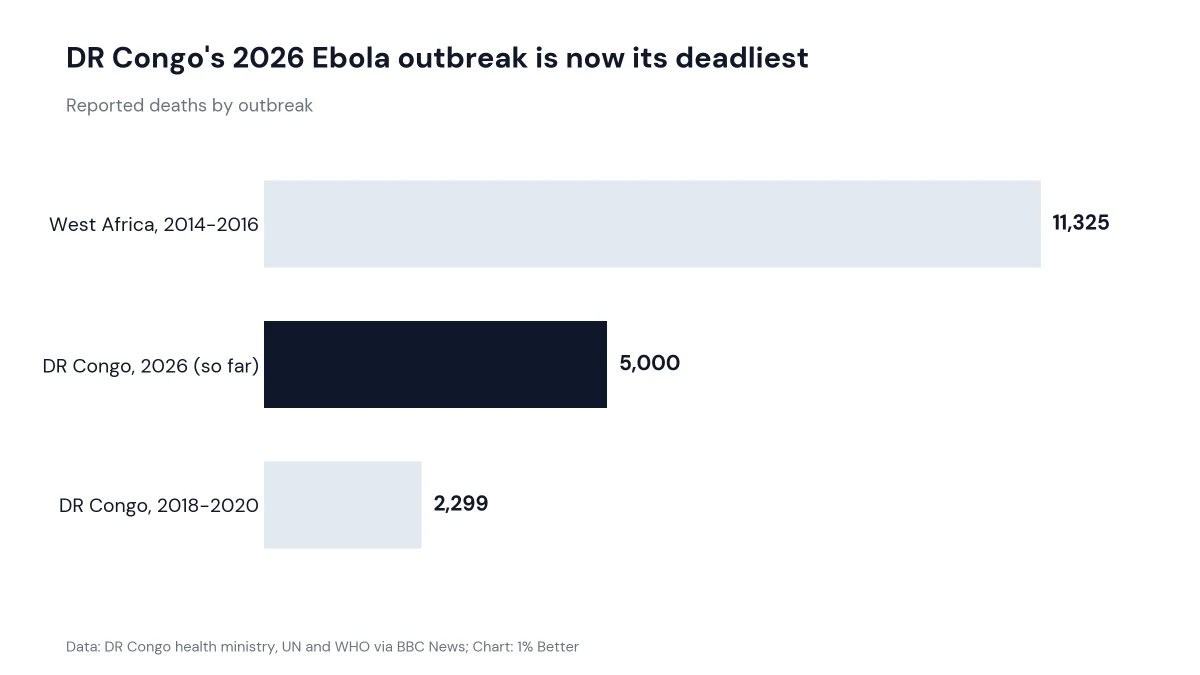
More than 5,000 people have died in the Democratic Republic of Congo's Ebola outbreak, government data shows, out of more than 10,300 confirmed cases.
By the numbers: The outbreak began in May and became DR Congo's deadliest in August, the current case fatality rate is 48.6%, and eight of the country's 26 provinces now have cases.
The backstory: This is the 17th Ebola outbreak in DR Congo's history and the second largest anywhere, per the United Nations, which says it is taking lives at a much faster rate than earlier epidemics.
- The previous worst outbreak in the country killed 2,299 people between 2018 and 2020, and the West Africa epidemic of 2014 to 2016 killed more than 11,325.
Zoom in: The epicenter remains Ituri province in the northeast, a conflict zone, which the health ministry says makes the virus harder to contain.
Yes, but: The Bundibugyo species driving this outbreak has no approved vaccine or treatment, though clinical trials of vaccines are under way, the World Health Organization said.
- Responders keep getting attacked: a politician was beaten to death last month after promoting control measures, and the Red Cross counted 11 violent incidents in the outbreak's first 100 days.
The big picture: Kenya has nine confirmed cases and two deaths, Uganda recorded 20 cases and two deaths before August, and Nigeria isolated two suspected cases on Saturday.
What's next: The WHO office in Africa called for a continued scale-up of control measures, greater access to affected areas and community outreach to end the outbreak.
Why it matters: The virus has already crossed borders into Kenya, Nigeria and Uganda, and Europe's disease agency still rates the chance of infection for people there as very low.