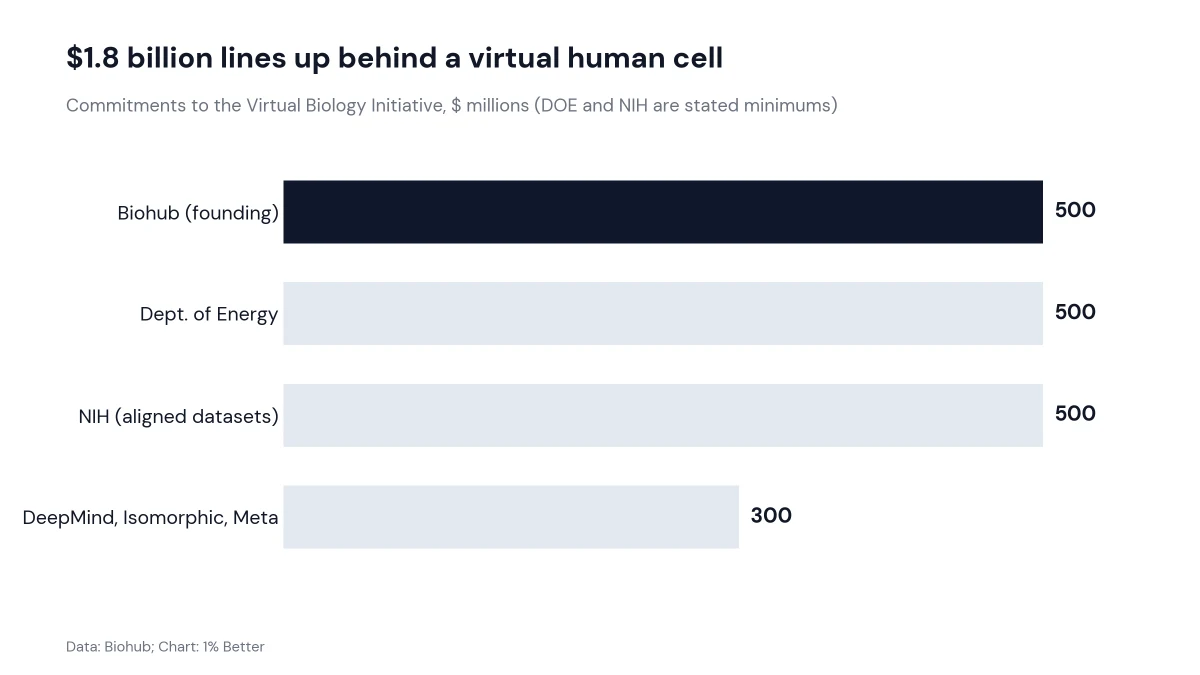
Biohub said Wednesday that it, the Energy Department, the National Institutes of Health and new partners are putting $1.8 billion into generating the biological data needed to model a cell.
By the numbers: The Energy Department will invest more than $500 million over five years in lab measurement, modeling and computation. NIH will coordinate datasets built on more than $500 million of prior federal investment, and Google DeepMind, Isomorphic Labs and Meta are together adding $300 million.
The backstory: Biohub, the research nonprofit funded by Mark Zuckerberg and Priscilla Chan, launched the Virtual Biology Initiative in April 2026 with $500 million of its own. Of that, $400 million went to measurement technology including cryo-electron tomography and microscopy that can image millions to billions of cells in living tissue.
Zoom in: The money buys data, not a model. The plan is to measure how cells respond to interventions across far more cell types and conditions than anyone has studied, then release the result openly so any lab can train on it.
- "Because of this potential, the creation of a virtual cell is one of the most important challenges for the next era of science," said Biohub Head of Science Alex Rives.
What they're saying: "Generating the data to solve predictive systems biology requires scaling past the limits of what any single organization can produce today," said Max Jaderberg, president of Isomorphic Labs.
The big picture: The Allen Institute, Broad Institute, Gladstone Institutes, the Human Cell Atlas, the Human Protein Atlas and the Wellcome Sanger Institute joined to shape scientific strategy, groups Biohub describes as experienced in international collaborations going back to the Human Genome Project. NVIDIA is also supporting the work.
Why it matters: If a model can predict how a cell reacts to a drug, the slowest and most expensive step in medicine moves from the bench to a computer. NIH deputy director Nicole Kleinstreuer said the return could be substantially faster timelines for medical breakthroughs.