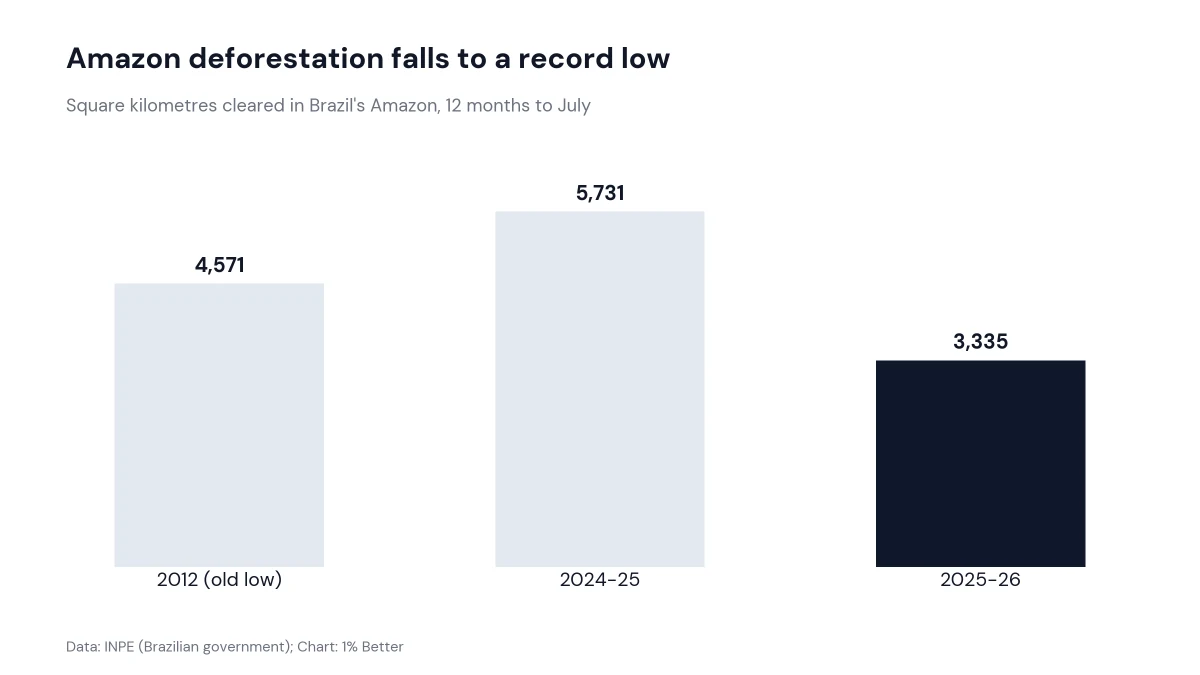
Brazil's national space research institute said Friday that Amazon clearing fell 41.8% over the past year to 3,335 square kilometres, a record low for a series that begins in 1988.
By the numbers: Clearing dropped to 3,335 square kilometres between August 2025 and July 2026, from 5,731 the year before. The previous low was 4,571 square kilometres in 2012.
Zoom in: Para lost the most forest at 1,130 square kilometres, down 45.3%, followed by Mato Grosso at 849 and Amazonas at 525, each down about 46%.
- Roraima was the only state to rise, by 0.4%, while Tocantins fell 73.3% and Amapa fell 52.9%.
The big picture: The Cerrado savanna also hit a record low at 5,516.69 square kilometres, down 23.8%. Four states known together as Matopiba accounted for 74.3% of that clearing.
The backstory: Brazil restored two federal deforestation control plans in 2023. Between 2023 and 2026 the environment agency Ibama ran 76,095 inspections, issued 25,101 citations against flora worth 11.8 billion reais and embargoed 18,630 square kilometres.
- Since January 2023 Brazil created 18 federal conservation units, expanded eight more and approved 20 Indigenous territories covering roughly 32,000 square kilometres.
What's next: The 2026/2027 farm credit plan now cuts borrowing costs by up to a full percentage point for producers with a clean environmental registry who adopt sustainable practices.
Why it matters: The Amazon stores carbon that shapes the global climate, and this is the first year enforcement has pushed clearing below the floor set in 2012.