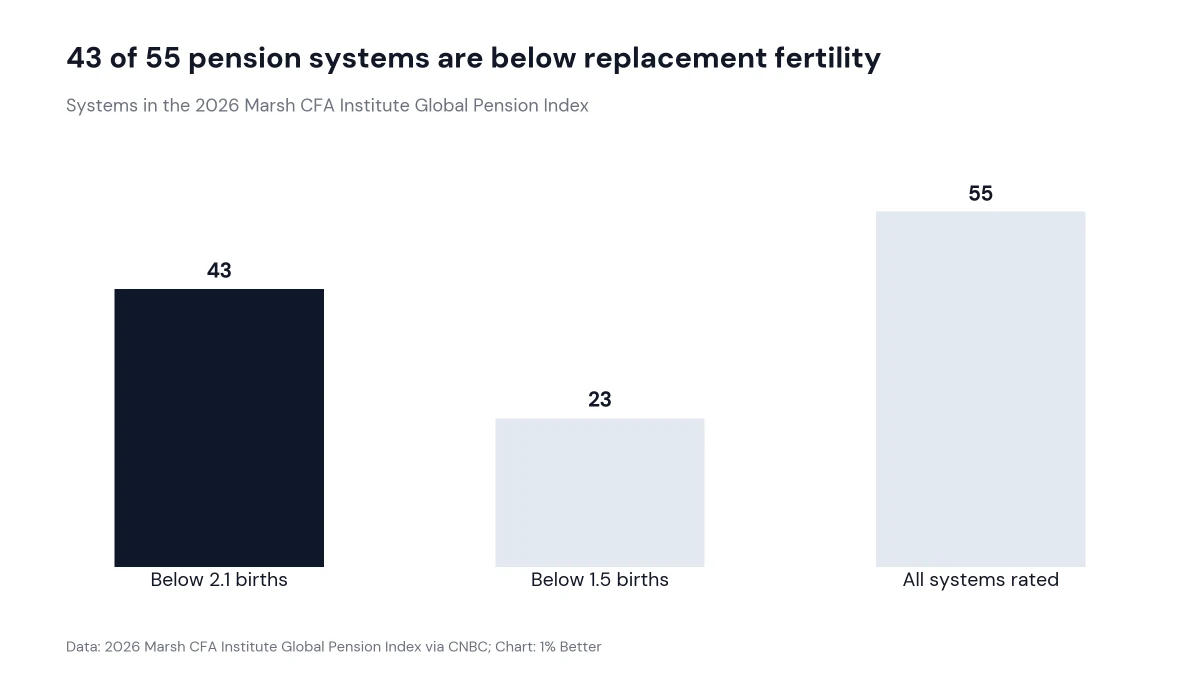
A global pension index covering 55 retirement systems found 43 of them have fertility rates below the 2.1 children per woman needed to hold a population steady.
By the numbers: Of the 55 systems in the 2026 Marsh CFA Institute Global Pension Index, 43 are below the 2.1 replacement rate and 23 are below 1.5. Life expectancy at age 65 in more developed regions has risen 50.9% since 1950, to roughly 20 additional years of benefits to fund.
- "The funding of future pensions and aged care both become more critical as the ratio of workers to retirees continues to decline," the report states. "Very few systems, as they currently operate, are secure."
Zoom in: Some funds now carry members who have been retired for nearly half a century, aged 107 or 108, said Sebastien Betermier, executive director at the International Centre for Pension Management. "Think about the cost that it imposes actually on the next generation: it is a ticking time bomb," he told CNBC.
The big picture: In the US, the Old-Age and Survivors Insurance Trust Fund that pays retirement and survivor benefits is projected to exhaust its reserves in the fourth quarter of 2032, per its latest trustees' report. Pay-as-you-go systems, where today's workers fund today's retirees, are the most exposed to a shrinking workforce.
Between the lines: The pressure is pushing funds into riskier assets. US state and local government pensions hold only about 20% of assets in bonds, far more exposed than peers in Europe and Canada, said Jean-Pierre Aubry of the Center for Retirement Research at Boston College. In Australia, about a third of superannuation funds ran negative natural cash flows over a three-year period.
- "Everybody is shifting a little more risk where they can. The costs are going up with this demographic shift," Aubry said.
Why it matters: If your retirement runs on a defined-contribution plan, the risk of outliving the money sits with you, and the fund's answer is to buy more private credit and private equity on your behalf. Worth checking what share of your own plan is in bonds, and what your plan assumes you will live to.