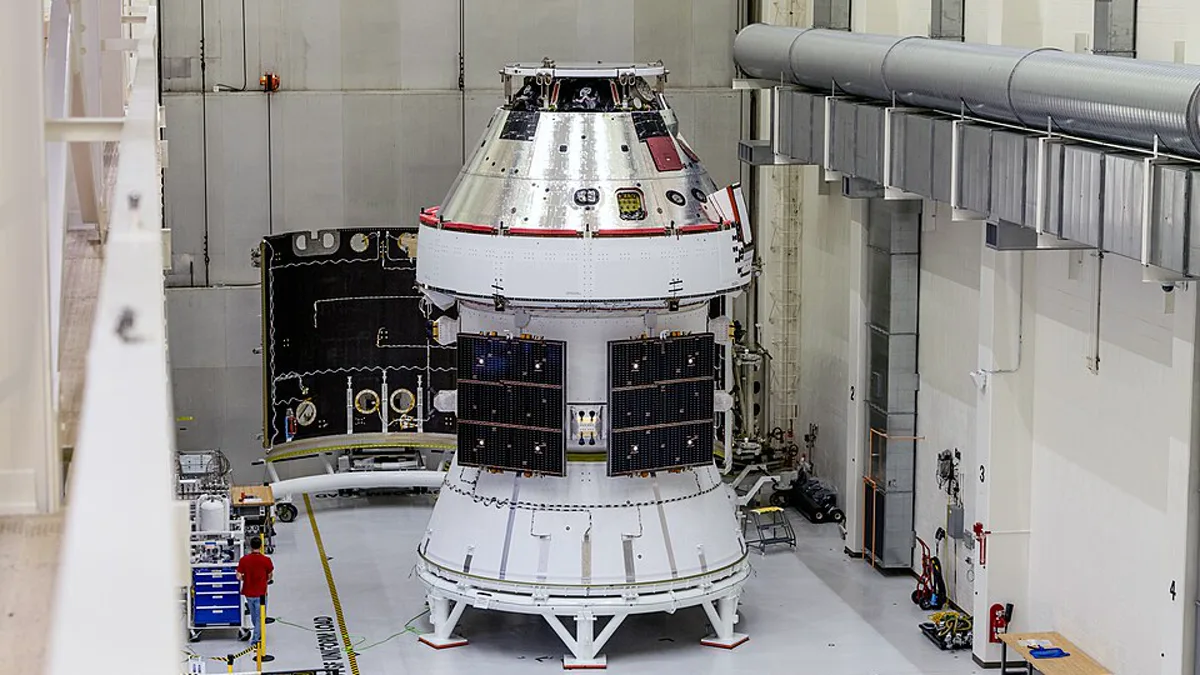
NASA said Friday that neither Blue Origin nor SpaceX holds an assignment to a specific Artemis lunar landing mission, and that lander readiness will determine who flies first in 2028.
The big picture: NASA and its two commercial lander providers have streamlined their designs and changed both concepts of operations for future crewed landers, the agency said in an update Friday.
Zoom in: Artemis III has been redefined as a demonstration in low Earth orbit next year. Astronauts Randy Bresnik, Frank Rubio and Andre Douglas, plus ESA's Luca Parmitano, will fly a planned 14-day mission aboard Orion and dock with test versions of both companies' landers.
- Blue Origin launches a Blue Moon Mark 2 test article into a circular orbit about 273 miles up, where it can wait as long as 30 days. SpaceX follows later in the mission with a Starship Version 3 test article at 206 nautical miles.
By the numbers: The mission puts three spacecraft on three different heavy-lift rockets inside a short window, something NASA has never attempted.
- "Every piece of this mission in Earth orbit is designed to reduce risk before we put astronauts back on the Moon," said Jeremy Parsons, NASA's Artemis program manager.
Between the lines: The landers and Orion will no longer meet in a near-rectilinear halo orbit around the Moon. Each provider now gets an orbit suited to its own systems, which cuts propellant needs and shortens the trip back up from the lunar surface.
The backstory: Under the original contracts SpaceX's Starship was assigned to Artemis III and IV, while Blue Origin's Blue Moon Mark 2 was slated for Artemis V. Both now take part in Artemis III in low Earth orbit.
What they're saying: "We are executing President Trump's National Space Policy to complete the long-awaited return of American astronauts to the lunar surface in 2028 and establish a Moon Base," NASA Administrator Jared Isaacman said.
Why it matters: Turning the landing assignment into a race gives NASA a second path if one vehicle slips, and it puts two of the most valuable private space companies in direct competition for the highest profile flight of the decade.