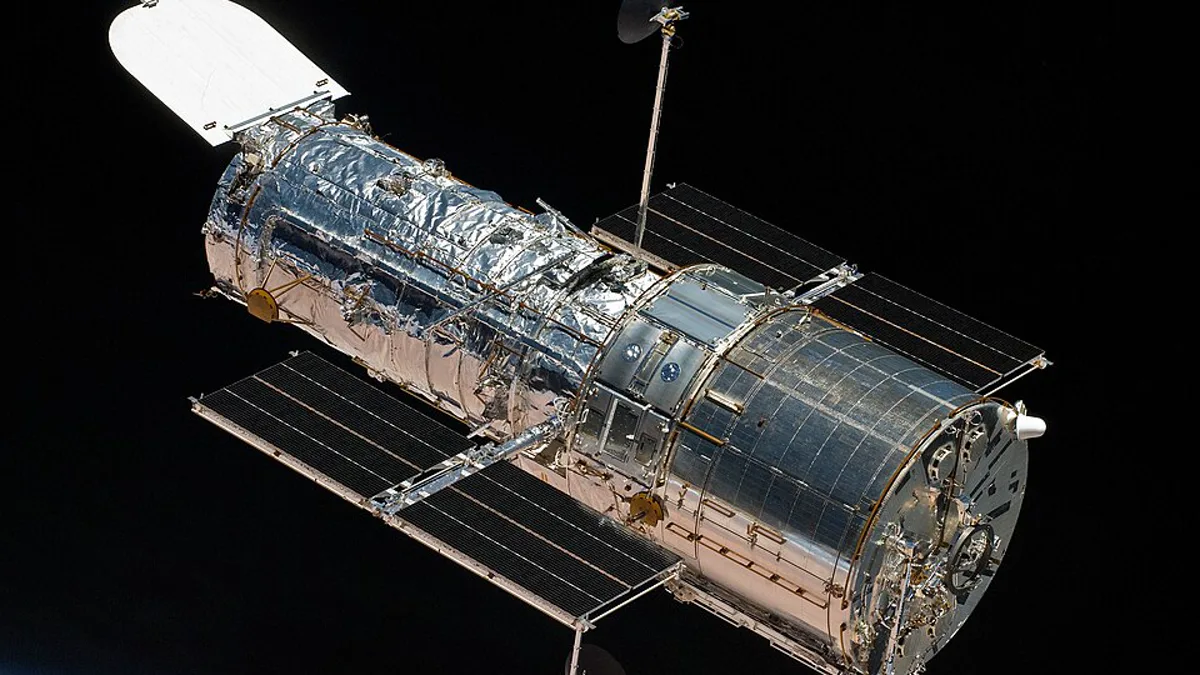
NASA has opened the door to a commercial mission for the Hubble Space Telescope, which has no engine of its own and is drifting toward re-entry in the early 2030s.
Zoom in: NASA issued a Request for Information on October 29 asking what industry could do for Hubble: boost it to a higher altitude to extend its science life, service it to enhance its capabilities, or perform a safe controlled re-entry or orbital disposal at end of mission.
- Responses are due by 3pm EST on Monday, November 30.
The big picture: Hubble carries no propulsion system, so atmospheric drag lowers its altitude year after year. NASA analysis predicts re-entry in the 2033 to 2034 timeframe, which is why the agency expects any mission to fly by 2032.
What they're saying: "Hubble still has important science ahead of it, and we should be looking at every reasonable opportunity to keep it delivering for as long as possible," NASA administrator Jared Isaacman said, adding that cost-effective ways to extend an asset already on orbit are owed to the American taxpayer.
- "Commercial industry has rapidly evolved in recent years to offer new capabilities for in-space satellite capture and servicing," said Nicky Fox, associate administrator for NASA's Science Mission Directorate.
The backstory: Hubble launched in 1990 and NASA says it has reshaped how humanity views the universe for more than 35 years. It returned to orbit as an improved telescope after its second servicing mission in February 1997. NASA and the European Space Agency run it jointly, Goddard Space Flight Center manages operations with support from Lockheed Martin Space, and the Space Telescope Science Institute in Baltimore runs the science.
Why it matters: Fox said NASA wants to lift Hubble while it develops the flagship mission that follows, which means a private spacecraft could be paid to catch and raise a national science icon. That would be a first, and the market NASA is testing here is the one every satellite operator will need next.