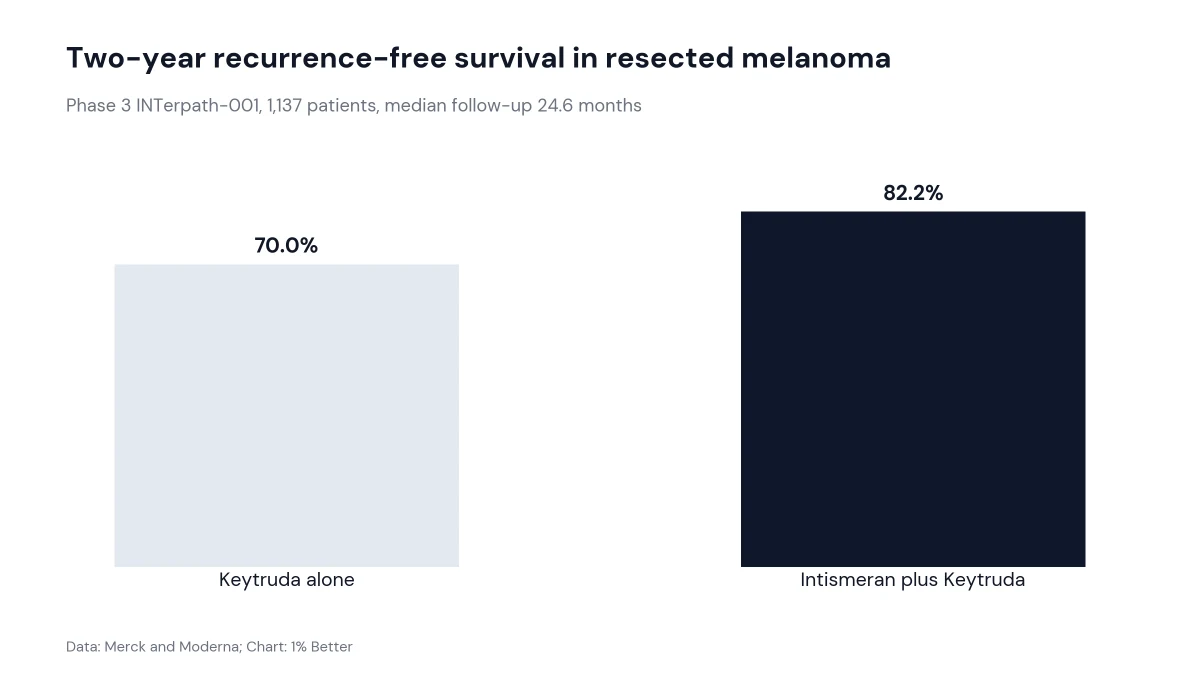
Adding Moderna's mRNA vaccine to Merck's Keytruda cut the risk of melanoma returning or killing patients by 42% in a 1,137-person trial, the companies said Thursday.
The big picture: For decades cancer treatment has been defined by where a tumor starts. INTerpath-001 tested a different idea: build every patient a shot coded for up to 34 mutations found in their own tumor.
- "These results reinforce our conviction that mRNA has the potential to fundamentally change how we treat cancer," Moderna CEO Stephane Bancel said.
By the numbers: Two-year recurrence-free survival reached 82.2% on the combination against 70.0% for Keytruda alone. The risk of distant metastasis or death fell 38%.
- The benefit arrived late. Through the first six months the two arms ran even, and the gap opened to 58% only after the nine-dose immunization course finished.
The backstory: Merck and Moderna have been testing the pairing since a Phase 2b melanoma study. Each dose is built from a patient's own tumor and healthy DNA, then translated into synthetic mRNA.
- "The INTerpath-001 findings support a fundamentally new and individualized approach," said Georgina Long, the principal investigator and medical director of Melanoma Institute Australia.
Yes, but: Overall survival data remain immature, so the trial has yet to prove the shot helps people live longer. Treatment-related side effects hit 95.8% of the vaccine arm, led by fever at 52.2%.
What's next: The companies say they are engaging regulators now. Nine trials are running across pancreatic, gastric and lung cancer, including three late-stage non-small cell lung studies.
Why it matters: About 112,000 Americans will be diagnosed with melanoma this year and more than 8,500 will die of it, and over half of patients who relapse develop distant metastases.