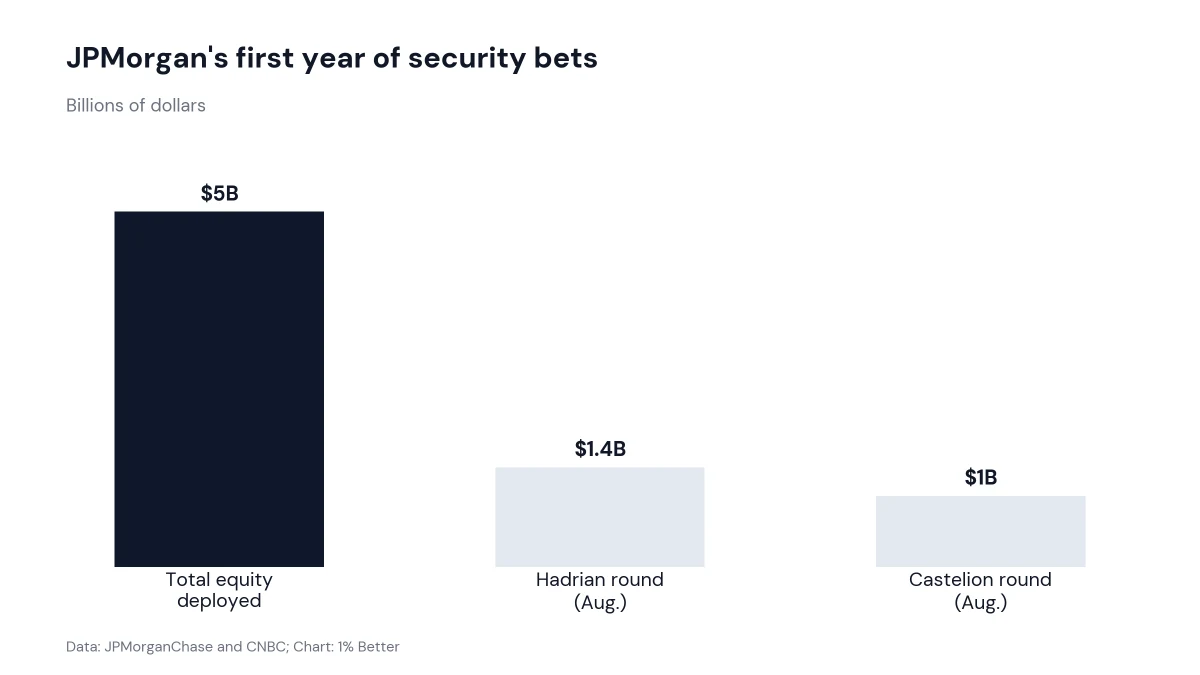
JPMorganChase said Monday it has deployed $5 billion of equity into startups in the first year of its Security and Resiliency Initiative, half the initial allocation.
By the numbers: The bank also financed and facilitated more than $230 billion across the initiative's five focus areas, against a 10-year goal of $1.5 trillion. Nearly one-third of that activity happened outside the United States.
Zoom in: Two disclosed stakes show the mission. JPMorgan helped lead a $1.4 billion round in August for Hadrian, which runs automated factories making parts for defense, aerospace and maritime customers, and joined a $1 billion round for Castelion that same month.
- A California factory run by Hadrian has 10 robots for every human employee, according to the startup's founder.
- Castelion's flagship product is a relatively low-cost hypersonic missile called Blackbeard. Former SpaceX engineers founded the company in late 2022.
What they're saying: "Putting $5 billion to work in our first year shows how many exceptional businesses are building in industries that strengthen critical supply chains," said Todd Combs, the former Berkshire Hathaway executive who heads the Strategic Investment Group.
The backstory: Wars in Ukraine and the Middle East, plus trade disputes with China, threatened the flow of energy and components US industry and defense depend on. That pushed CEO Jamie Dimon to launch the initiative a year ago. Co-President Doug Petno told CNBC the program may expand past $10 billion.
Between the lines: Direct startup stakes are a departure for JPMorgan, which spun off its private equity arm, One Equity Partners, more than a decade ago and had stepped back from venture bets. The team now runs more than 35 professionals including 13 managing directors, and has mapped seven critical value chains.
Why it matters: The biggest US bank by assets is now underwriting the industrial base directly. Its bankers trace distribution lines for submarines, missiles and aircraft to find suppliers short on capital, and they talk regularly with the Defense and Commerce departments about what the government needs.